

A recurring truth echoed throughout the final session of MRANTI’s Commercialisation Blueprint Forum:injecting capital into innovation without a clear market pathway may generate activity, but not necessarily sustainable impact.
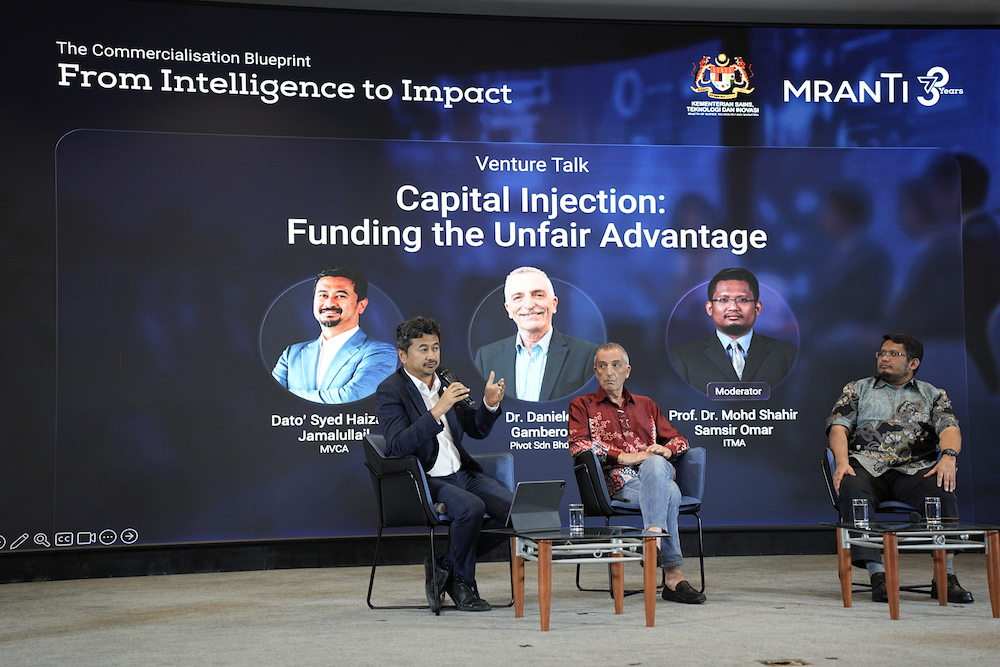
In today’s hyper-competitive landscape, capital alone is no longer a differentiator. True ecosystem maturity occurs when funding is intentionally leveraged to back technologies that already command a defensible, validated “unfair advantage” in the real market.
The Capital Paradox: Two Structural Gaps
The panel candidly addressed the reality that capital allocation in Malaysia currently faces two core structural mismatches:
- The Early-Stage Deep Tech Chasm: Traditional venture capital often exercises greater caution about university-originated deep tech due to steep technical risks and prolonged commercialisation timelines.
- The B2B Direction Deficit: Conversely, many enterprise-level startups struggle not from a lack of technical capability, but from a lack of market direction—building highly sophisticated solutions for problems that the industry hasn't actually validated.
To correct these mismatches, the forum outlined two definitive, demand-driven shifts to transform how innovation is funded in Malaysia.
Two Strategic Shifts to Reorient Capital
1. Dedicated University-VC Matching Funds
To close the early-stage deep tech chasm, the ecosystem requires structured co-investment mechanisms. Establishing 1-to-1 matching funds specifically earmarked for university intellectual property allows government-linked capital to systematically de-risk deep tech ventures. This effectively "crowds in" private venture capital, ensuring that breakthrough research is never stranded at the prototype phase by market risk aversion.
2. Curated Problem Statements over Speculation
Startups should no longer have to guess what the market needs. The ecosystem must pivot toward executing on curated, validated problem statements sourced directly from corporate industries and national socioeconomic priorities. This fundamentally shifts the ecosystem from a traditional "technology push" to an aggressive, demand-driven "market pull." Startups will build solutions with defined buyers, pre-allocated budgets, and clear demand signals established on day one.
Shifting the Investor Mindset
Mechanisms like matching funds and corporate problem statements are only half the battle; investor behavior must change, too. By utilising accelerators and regulatory sandboxes—such as the National Technology and Innovation Sandbox (NTIS)—the ecosystem can expose angel investors and VCs to live, validated pilots. This shifts investment logic away from superficial financial projections and toward the hard metrics that matter: technological defensibility, scalability, and long-term ESG value.
The Verdict: Execution is the New Currency
This brings the entire Commercialisation Blueprint Forum series to its ultimate, definitive conclusion: a patent is not an economic asset by default. It is merely an unactivated balance-sheet entry until it is operationalised, adopted by industry, and scaled into the market.
Ultimately, Malaysia's next phase of innovation maturity hinges on moving from passive capital allocation to active value creation. Patents must no longer be viewed as the endpoints of academic research, but as the launching pads for scalable corporate industries.
As Malaysia’s Technology Commercialisation Accelerator (TCA), MRANTI remains committed to anchoring this transition—ensuring that our nation's brightest inventions successfully cross the chasm to achieve real-world economic impact.
16
30